Durga Boilers is a trusted name in industrial heating solutions, offering reliable equipment for applications where controlled and consistent hot air is required. A hot air generator is an important heating system used across industries for drying, heating, curing, and processing. Understanding the hot air generator working principle helps industries select the right system according to their production requirements.
What Is a Hot Air Generator?
A hot air generator is an industrial heating equipment designed to produce and circulate heated air. It generally consists of a combustion chamber or heating arrangement, air circulation system, burner or fuel source, insulation, and control system. Depending on the application, these generators can operate using fuels such as diesel, gas, biomass, or other suitable energy sources.
Durga Boilers offer hot air generation solutions designed for different industrial applications. Their approach focuses on practical operation, efficient heat utilization, and dependable performance.
How Does a Hot Air Generator Work?
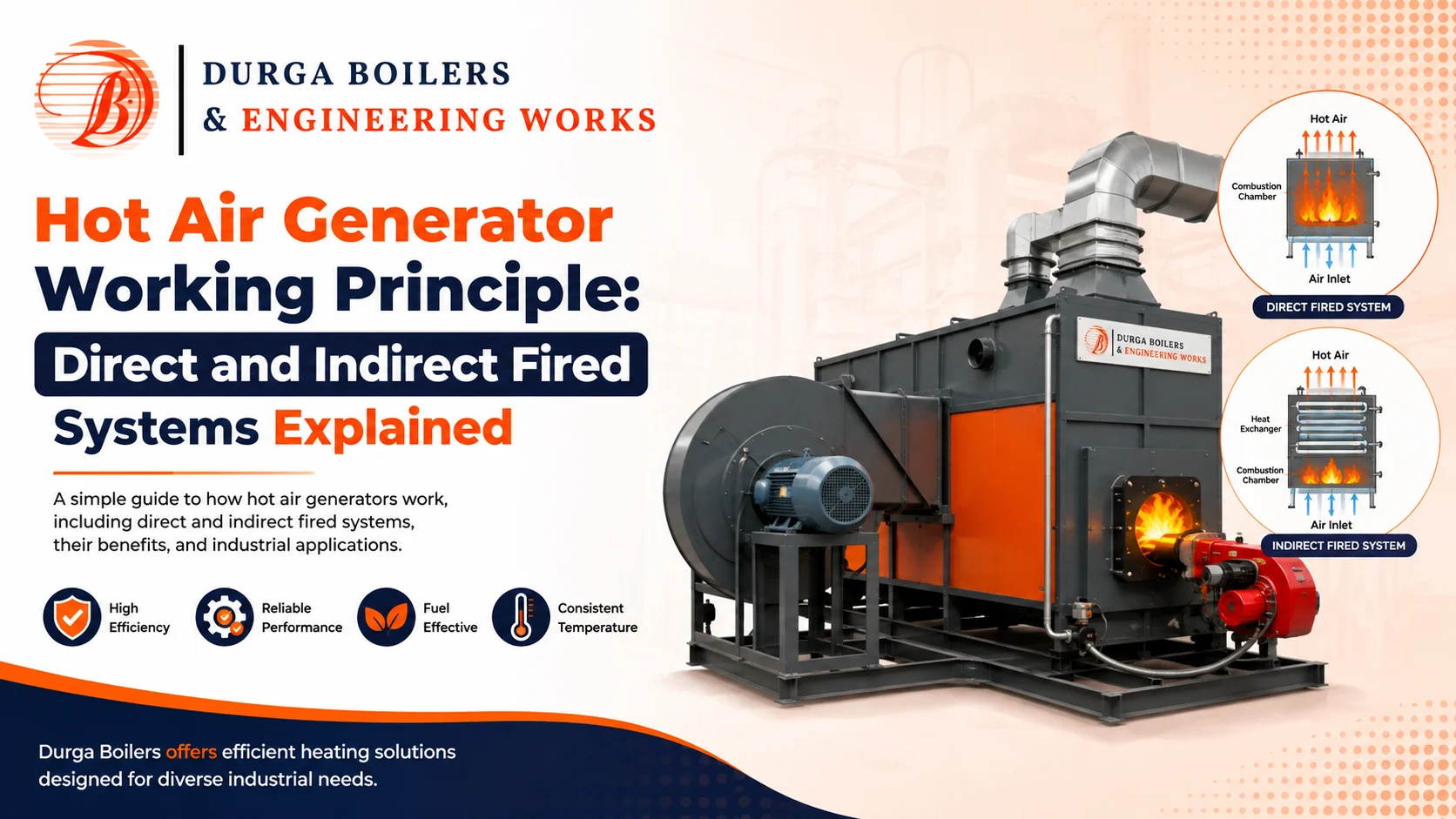
The basic working principle starts with the generation of heat. Fuel is supplied to the burner or combustion system, where it is burned to produce thermal energy. Air is then heated either directly by coming into contact with combustion gases or indirectly through a heat exchanger.
A blower helps move the air through the heating system and delivers it to the process area. Temperature controls monitor the system and help maintain the desired operating conditions.
The two main types are:
- Direct fired hot air generator
- Indirect fired hot air generator
Both systems generate hot air, but their methods of heat transfer are different.
Direct Fired Hot Air Generator Working Principle
In a direct fired system, the combustion gases mix directly with the air that is being heated. Fuel burns inside the combustion chamber, producing hot gases. A controlled quantity of processed air passes through or around the combustion zone and mixes with these gases. The heated air is then circulated toward the application through ducts or an air distribution arrangement.
Advantages of Direct Fired Systems
Direct fired hot air generators are often selected when direct contact between combustion gases and process air is acceptable. Some important benefits include:
- High heat transfer efficiency
- Quick heating response
- Simple construction
- Lower initial equipment cost in many applications
- Effective fuel utilization
- Suitable for several drying and heating processes
However, the combustion gases become part of the hot air stream. Therefore, the system is not suitable for applications where the product requires clean, uncontaminated air
Indirect Fired Hot Air Generator Working Principle
An indirect fired hot air generator works differently. In this arrangement, the combustion process takes place separately from the process air.
Fuel is burned inside a combustion chamber, and the resulting hot gases flow around a heat exchanger. The process air passes over the other side of the heat exchanger. Heat transfers through the exchanger walls without allowing combustion gases to mix with the process air.
Advantages of Indirect Fired Systems
Indirect fired systems provide several useful advantages:
- Clean hot air output
- No direct mixing of combustion gases with process air
- Suitable for sensitive products
- Better control over process air quality
- Useful for food, pharmaceutical, chemical, and other applications
- Flexible temperature control
The main limitation is that heat must pass through a heat exchanger, which can result in somewhat greater heat-transfer losses compared with direct firing.
Applications of Hot Air Generators
A hot air generator can be used in a wide range of industrial processes. Common applications include:
- Industrial drying
- Food and grain drying
- Textile processing
- Paint and coating curing
- Chemical processing
- Pharmaceutical manufacturing
- Wood and timber drying
- Paper processing
The required temperature and airflow can vary significantly from one application to another. Therefore, proper sizing is essential for achieving efficient operation.
The hot air generator working principle is based on generating heat and transferring that heat to air for industrial use. Direct fired systems transfer heat directly into the process air and can provide efficient, rapid heating, while indirect fired systems use a heat exchanger to provide clean hot air without combustion-gas contamination.
The right choice depends on the application, product sensitivity, temperature requirements, fuel source, and desired efficiency. Durga Boilers offer dependable industrial heating solutions designed around different process requirements. With appropriate selection, installation, and maintenance, a hot air generator can provide consistent heating performance and support efficient industrial production.