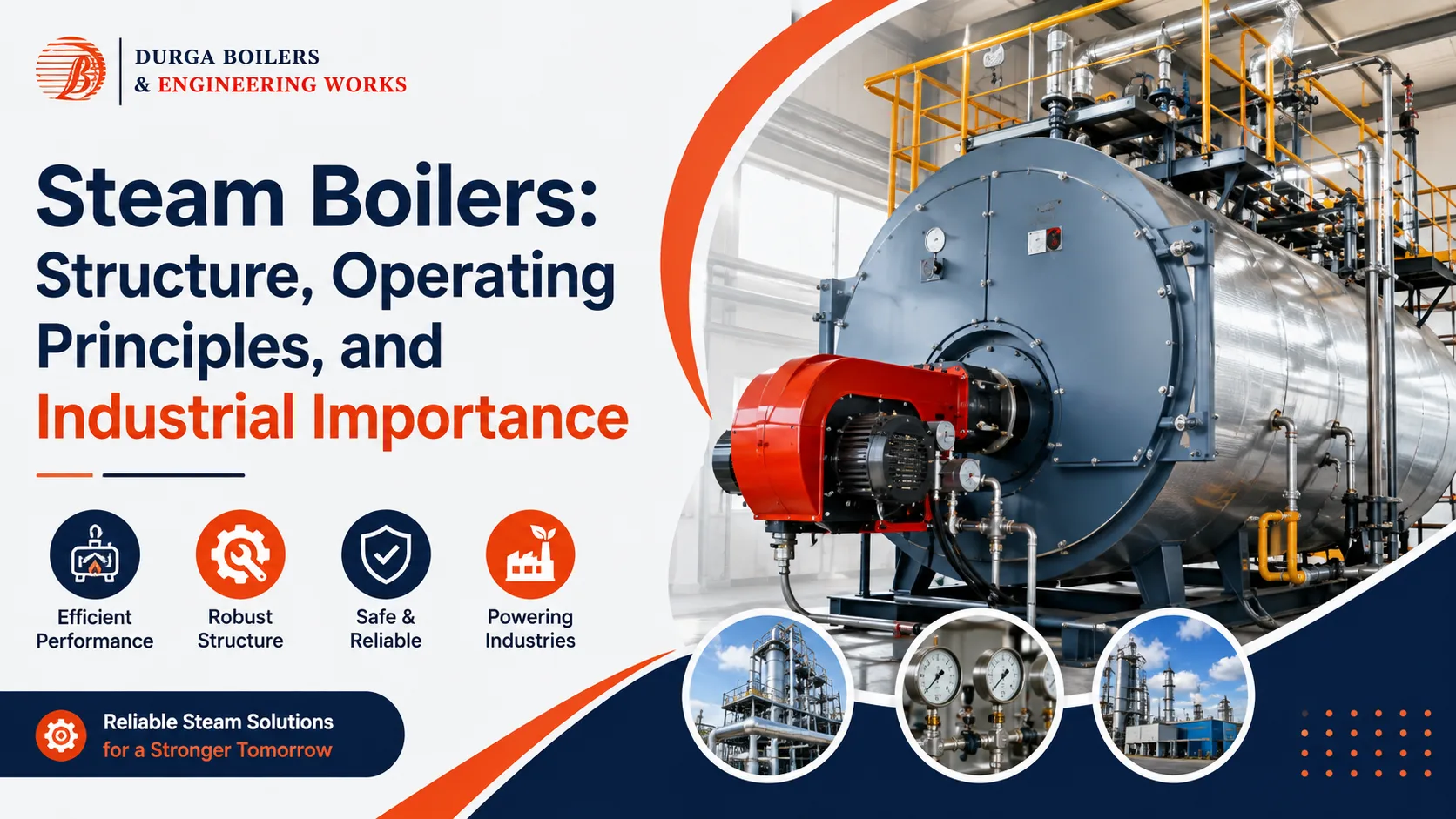
Durga Boiler is a trusted name in industrial heating and steam generation solutions, offering steam boiler systems designed to support the demanding requirements of different industries. From manufacturing facilities and food processing units to chemical plants, textile industries, and commercial operations, a reliable boiler can play an important role in maintaining continuous production. Understanding the boiler structure, working principle, and industrial applications helps businesses choose the right system for their specific requirements.
What Is a Steam Boiler?
A steam boiler is a closed vessel designed to heat water and convert it into steam using energy from a fuel source or another heating method. The generated steam can then be used for heating, processing, drying, sterilization, power generation, and several other industrial applications.
The basic concept is simple, but modern boilers include several carefully designed components to improve efficiency, safety, and steam quality. Depending on the application, boilers can use fuels such as coal, biomass, oil, gas, or other suitable energy sources.
Understanding Boiler Structure
The boiler structure consists of multiple components that work together to generate and distribute steam efficiently. Although the exact design differs according to boiler type and capacity, common components include:
- Boiler shell or pressure vessel
- Furnace or combustion chamber
- Burner or fuel-feeding system
- Water tubes or fire tubes
- Steam drum
- Water drum
- Superheater
- Economizer
- Air preheater
- Safety valves
- Pressure gauges
Each component performs a specific function. The pressure vessel holds water and steam under controlled conditions, while the furnace provides the heat required for water conversion. Heat-transfer surfaces allow energy from combustion gases to pass into the water.
How Does a Steam Boiler Work?
The working principle of a steam boiler begins with the supply of feedwater into the boiler. The water enters the designated section through a feedwater system and is heated using energy generated by combustion. When fuel burns inside the furnace, hot gases are produced. These gases pass through heat-transfer surfaces, transferring their heat to the surrounding water. As the water temperature rises, it gradually changes into steam.
The steam collects in the steam space or drum before being supplied to the required application. In some industrial systems, steam passes through a superheater to increase its temperature before entering the process line. Modern systems may include heat-recovery equipment such as economizers and air preheaters to make better use of waste heat.
Main Components of a Boiler
Furnace
The furnace is the area where fuel is burned or heat is introduced. It must be designed to provide suitable combustion conditions while allowing efficient heat transfer.
Boiler Shell
The shell or pressure vessel contains water and steam. It is manufactured to withstand the pressure and temperature generated during operation.
Heat Transfer Tubes
Tubes provide an effective surface for transferring heat between hot combustion gases and water. Their arrangement depends on whether the boiler is a fire-tube or water-tube design.
Steam Drum
The steam drum separates steam from water and provides a space for collecting generated steam. It is particularly important in many water-tube boiler designs.
Safety Valves
Safety valves are essential protective components. They help release pressure if it rises beyond the permitted operating limit, protecting the equipment and surrounding personnel.
Economizer
An economizer uses heat from outgoing flue gases to preheat feedwater before it enters the main heating area. This can improve overall thermal efficiency and reduce fuel consumption.
Types of Steam Boilers
Different industries require different boiler designs. Some commonly used types include:
- Fire-tube boilers
- Water-tube boilers
- Biomass-fired boilers
- Oil-fired boilers
- Gas-fired boilers
- Electric steam boilers
- Waste-heat boilers
Fire-tube boilers generally pass hot gases through tubes surrounded by water, while water-tube boilers circulate water through tubes exposed to hot gases. The selection depends on factors such as required steam pressure, capacity, fuel availability, operating conditions, and application.
Industrial Applications of Steam Boilers
Steam is used across many industries because it provides an efficient and controllable method of transferring heat. Common applications include:
- Food processing
- Dairy processing
- Pharmaceutical manufacturing
- Textile production
- Chemical processing
- Paper manufacturing
- Rubber and plastic industries
- Sugar processing
- Oil and gas applications
- Hotels and commercial facilities
In food and dairy plants, steam can be used for cooking, pasteurization, sterilization, cleaning, and heating. In textile manufacturing, it can support processes such as drying, finishing, and fabric treatment.
Industrial Importance of Steam Boilers
A reliable boiler is often an essential part of continuous industrial production. If steam supply becomes inconsistent, several production processes may slow down or stop.
A properly selected boiler can provide stable steam generation while supporting better energy management. Modern systems can also incorporate automation, monitoring, heat recovery, and combustion controls to improve operating efficiency.
Benefits of a Modern Boiler System
Modern boiler systems can provide several practical advantages:
- Consistent steam generation
- Improved fuel utilization
- Better temperature control
- Reduced manual operation
- Enhanced operational safety
- Easier monitoring
- Improved thermal efficiency
- Reduced production interruptions
- Scope for automation
- Compatibility with different industrial applications
The actual performance depends on correct sizing, fuel quality, operating practices, maintenance, and overall system design.
Why Choose Durga Boiler?
Every industrial facility has different steam requirements, so selecting equipment based on actual application is important. Durga Boiler offers boiler solutions designed to meet different industrial heating and steam-generation requirements. Our company focuses on practical engineering, suitable capacity selection, dependable construction, and efficient operation. Whether a business needs steam for manufacturing, processing, heating, or other industrial applications, the boiler should be selected after considering fuel type, steam pressure, capacity, operating hours, and available infrastructure.
Steam boilers are an important part of many industrial processes, providing controlled steam for heating, processing, sterilization, drying, and other applications. With suitable design, regular maintenance, proper water treatment, and safe operating practices, a steam boiler can provide dependable performance for demanding industrial environments. Durga Boiler offers industrial boiler solutions that can help businesses establish efficient and reliable steam-generation systems according to their specific production requirements.