

Durga Boilers & Engineering Works is a trusted name in the power and boiler industry, we deliver efficient thermal solutions for industrial and power generation applications. Our company continues to offer high-performance boiler systems and engineering solutions that support reliable energy production. Understanding the thermal power plant working process is essential for students, engineers, and industries involved in power generation.
What is a Thermal Power Plant?
A thermal power plant is a facility that converts heat energy into electrical energy. The plant uses fuel such as coal, natural gas, biomass, or oil to generate heat. This heat is used to convert water into high-pressure steam, which drives a turbine connected to a generator. The generator then produces electricity that is supplied to homes, industries, and commercial establishments.
Thermal power plants remain one of the most widely used methods of electricity generation due to their ability to produce large amounts of power continuously.
Also Read : What Is the Difference Between Boiler Accessories And Boiler Mountings?
How Thermal Power Plant Works
The thermal power plant working process involves several interconnected systems that work together to generate electricity efficiently.
- Fuel Combustion: The process begins with fuel combustion inside the boiler furnace. Coal is the most commonly used fuel, although gas and biomass can also be utilized.
- Steam Generation: The heat produced in the furnace is transferred to water circulating through boiler tubes. As the water absorbs heat, it converts into high-pressure steam.
- Turbine Operation: The high-pressure steam flows toward the steam turbine. As the steam expands through the turbine blades, it causes the turbine shaft to rotate at high speed.
- Electricity Generation: The rotating turbine shaft is connected to a generator. The generator converts mechanical energy into electrical energy through electromagnetic induction.
- Condensation Process: After leaving the turbine, the steam enters a condenser where it is cooled and converted back into water.
- Feed Water Cycle: The condensed water is pumped back into the boiler, completing the cycle and allowing continuous power generation.
Principle of Thermal Power Plant
The basic principle of a thermal power plant is the conversion of heat energy into mechanical energy and then into electrical energy.
The process follows these steps:
- Fuel is burned in a boiler to produce heat.
- Heat converts water into high-pressure steam.
- Steam rotates a turbine.
- The turbine drives a generator.
- The generator converts mechanical energy into electrical energy.
- Electricity is transmitted through power lines for distribution.
This simple yet effective process forms the foundation of modern thermal power generation.
Explain Thermal Power Plant with Diagram
The operation of a thermal power plant can be understood through a simplified flow sequence.
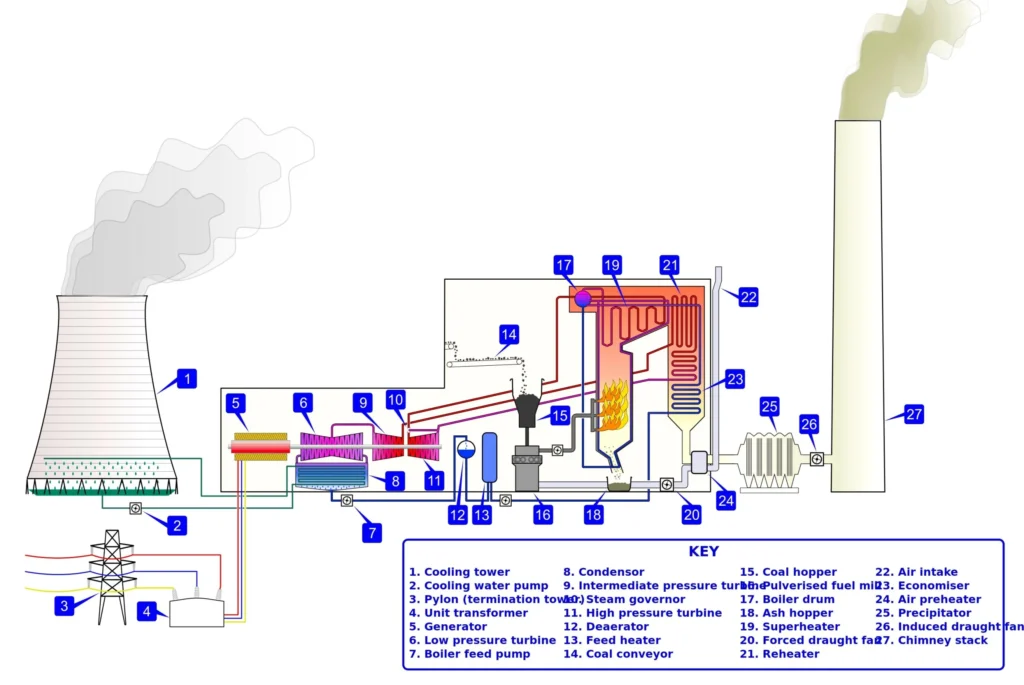
Diagram of Thermal Power Plant
A schematic diagram of a thermal power plant generally shows the flow of fuel, steam, water, and electricity through different components of the system. The schematic includes:
- Coal Handling System
- Boiler Furnace
- Steam Drum
- Superheater
- Steam Turbine
- Generator
- Condenser
- Cooling Tower
- Feed Water Pump
- Transmission System
The schematic diagram helps visualize the complete energy conversion process and the interaction between various plant components.
Advantages of Thermal Power Plants
Thermal power plants continue to play a significant role in global power generation because of several advantages:
- Reliable Power Generation: They can generate electricity continuously regardless of weather conditions.
- Large-Scale Production: Thermal plants are capable of producing substantial amounts of electricity for industrial and residential consumption.
- Established Technology: The technology is well-developed, making operation and maintenance relatively straightforward.
- Flexible Fuel Options: Many plants can operate using coal, gas, oil, or biomass fuels.
Role of Boilers in Thermal Power Plants
Boilers are among the most important components of thermal power plants. Efficient boiler performance directly impacts plant efficiency, fuel consumption, and power output. This is where Durga Boilers & Engineering Works contributes by delivering reliable boiler solutions for industrial and power generation applications.
Our company continues to offer advanced boiler systems designed to maximize steam production, improve fuel efficiency, and support long-term operational reliability.
Understanding the thermal power plant working process helps explain how heat energy is converted into electricity. The working of thermal power plant involves fuel combustion, steam generation, turbine operation, electricity production, condensation, and water recirculation. With growing energy demands worldwide, thermal power plants continue to play a crucial role in electricity production, supported by reliable boiler technologies from companies such as Durga Boilers & Engineering Works, which provide efficient solutions for modern power generation needs.
